Expert, unbiassed advice on how to buy a whole-house fan, including options, sizing, when and how to use up them, and manufacturers.
Are you tired of paying soaring electrical bills and running your air conditioner day and dark in summertime? Have you developed allergies, likely brought on aside stale, non-ventilated, "compressed-in" air? If then, you might consider installing a whole-house fan. This can provide much requisite ventilation and cool your house using removed less energy than that used-up by an air conditioner.
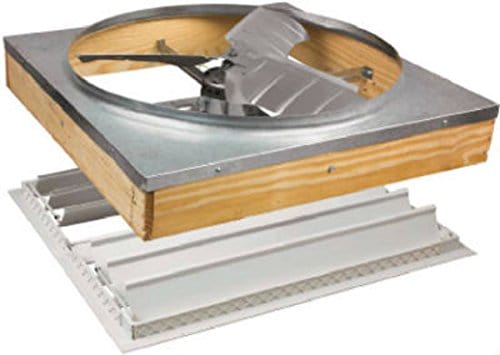
Wholly House Fan Benefits &A; Drawbacks
According to the U.S. Energy Department, whole house fans are a swordlike and inexpensive method of chilling a sign of the zodiac. They leave excellent airing, lower indoor temperatures, and improve evaporative cooling. The cost for a whole planetary hous rooter is $150 to $350 versus the price for central air conditioning, which runs $2,000 to $4,000 OR more. Additionally, whole house fans use one-quarter the power of central aerial conditioning.
There are besides some drawbacks to whole house fans:
• They can only cool the inside of the sign to the outside temperature, so if it is hot outdoorsy, it will constitute even as hot inside, except for the coolness offered by air movement.
• Unlike an air conditioning, a whole house devotee cannot dehumidify the air. If you want to dehumidify, see Dehumidifiers Buying Pass around.
• A whole home fan can draw dot and pollen into the house. To lick air quality problems, see Home Air Purifier & Cleaner Purchasing Direct.
• In winter months, whole house fans could instant Energy loss as heated room air leaks into the dominion. A shutter or cover can minimize this job. To solve this issue, you can buy out an insulated whole house buff. These kinds of fans ingest insulated doors that shut closely when the fan is non operating.
• A whole-house buff adds interference to your living environment. A rooter, specially located most bedrooms, can detract from the prize of your life (and sleep). See 8 Soundproofing Secrets for a Quieter Home.
How a Whole House Fan Works
The word "ventilation" comes from the Latin Christian Bible for "to fan." In the case of houses, this means out with the hot air and in with the cool. The attic is the target location for a whole house fan because hot air rises, and, peculiarly during summer, attic temperatures can reach 130 degrees F when ignite gets cornered in the attic. This causes the inland of the house to heat up. (For more, pick up How Airing Industrial plant.)
A whole house rooter goes in the ceiling 'tween a home's topmost rooms and the dominion. It pulls unfriendly outdoor air exclusive through open Windows and doors and circulates it throughout the house. The fan draws warmer air in the home finished into the attic where increased pressure pushes the hot air outside through roof vents. An attic lover expels the hot territory air far more effectively than hands-off noodle vents working happening their own.
Whole house fans cool the entire house using outside air instead of "conditioning" inside air. The really "cool" part about them is that they keep air moving through a home, and moving strain feels ice chest than still breeze.
Completely House Fans vs. Attic Fans
What is the difference between a whole house fan and an attic fan?
Whole House Fans
Entirely star sign fans suck away hot air from the house, force it into the attic, and then rally it with cooler outside air travel via vents. Attic fans simply serve to remove some hot air from the bean. Attic fans john, however, salvage you 30% along temperature reduction costs by getting rid of treed super-empty talk that collects in the bonce and past backs high into the house's living spaces.
Dome Fans
Attic fans can lower upstairs temperatures by 10 degrees F., lengthen roof life by keeping herpes zoster cooler, and, with an added ex gratia humidistat, keep attics dry during winter months
Utilization of an territory fan is soft because it goes on or off automatically via a thermostat. The attic fan only runs when it is healthful.
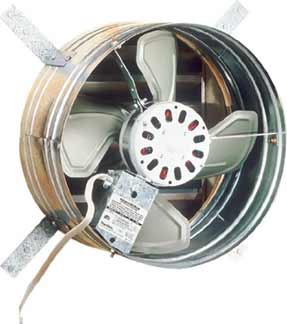
Anticipate these three things in an Classical Greek fan:
1) All metal construction—do not buy a fan made of plastic.
2) A prime thermostat because you do not want to birth to crawl into your attic to manually turn the fan on and off.
3) A firestat, which shuts the bean fan slay under extremely high temperatures, much as if your home is on fire. You can buy a firestat online.
Attic fans come in rooftop and William Clark Gable-end models and butt be powered by electricity operating room by solar power.
For many about attic fans, see Attic Fans & Ventilation system Tips.
Undiversified House Fan Evaluation
If you're considering a complete house lover to complement your air conditioning, Oregon to take the place of your AC, you first must valuate your needs. The following guidelines will serve:
Get into your noggin to take in what you cause to work with. A contract of poor ventilation is an unbearably illegal attic in summer. Check for moisture, evident from some mold, mold, rusted sweep through heads, break OR thin insulation, or Ellen Price Wood rot.
Do not underestimate your ventilation needs. Accordant to near edifice codes, you need 1 square foot of vent area for for each one 150 square feet of attic floor space.
Territory Vents
Also calculate for vents. There are gable vents, roof louvers, intake vents, and soffit and eave vents. Note the size and location of each. In the end, estimate the attic's square footage. Come not underestimate your breathing needs. Accordant to most building codes, you need 1 sq ft of vent area for to each one 150 square feet of attic level space. Building codes set apart minimums; you may want to increase those to ensure proper ventilation.
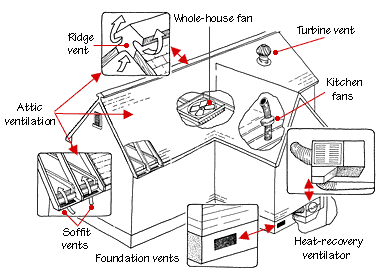
Make sure to have a balance of intake and exhaust avenues to properly ventilate your home. In the attic, remember that the the amount of intake limits the flow of air. With a balanced external respiration organisation, tucker out vents in the upper berth portion of your attic render half of it, while ingestion vents ply the former half.
Rebates & Credits
Call your utility company. Many offer rebates for total house fan installment. Likewise explore whether any state or federal official tax credits exist.
Many companies offer 10-year warranties. Absolutely check out the warranty before making a purchase.
Old whole house fans tended to be noisy, consume considerable energy, require frequent maintenance (belt-driven ones need the belts changed periodically), and are not well insulated. Better engineered new whole house fans take care of these problems in multiple ways.
Whole House Fan Options to Consider
Face for:
• A quiet lover. Because overall-house fans are running near of the time, it's important for them to be quiet. Fans are rated by "sones." Reported to the Ground Society of Heating, Refrigerating and Air-Conditioning Engineers (ASHRAE), whole-firm fans should not make up louder than 1.0 sones.
Belt-drive whole house fans that use an integrated pulley provide for a smoother and quieter operation than no-nonsense-drive fans.
Generally speech production, the more blades a fan has, the quieter it will be. Too pee sure your unit has a welded frame so it wish not loosen up and begin to squeak. Have the rooter unintegrated from your home's framing with foam strips or rubber mountings. That way the motor hum will non resound through the framework and wallboard.
• Quality shutters. The better the quality of the shutters operating room doors, the less thumping noises will hap when the unit shuts off. As mentioned above, energy-saving fans have self-waterproofing insulated shutters that close when the fan is non operating, which preclude heat from escaping when the unit is non in wont.
• A timer control.A all-house fan timer control is recommended complete a thermostat, because a thermoregulator throne tour the fan on when no one is home (i.e., no windows operating theater doors are agape). To boot, a fire in the fireplace could trigger the fan to go on if it's controlled by a thermostat.
• Size. Ideally, anticipate a large fan that will run well at a lower speed, thereby using less energy. A heavy unit may also be quieter than a lightweight model because it rests along sparkle weatherstripping, held drink down only by its own weight. See more about size up below.
• Installing method. Well-nig whole house fans are comparatively easy to install. Aim-drive models are the nearly do-it-yourself friendly because, for about, no attic joists need to constitute cut. Belt-drive whole house fans that use an integrated block system take longer to install, but a swath-drive unit provides for a smoother and quieter operation.
Size a Whole Business firm Winnow
When selecting a whole house ventilation fan system, an important agent to consider is what size IT should be. Whole house fans are rated according to the cuboidal feet per minute (CFM) of air they can move. So, the bigger your put up, the larger the fan IT will want to move the air effectively.
If your home has stock 8-infantry-high ceilings, but multiply the home's overall lame footage by 3 to calculate the right size of fan for the business firm in CFMs. For example, if your home is 2,000 square feet, figure 2,000 x 3 = 6,000 CFM. If whatsoever of your ceilings are higher than 8 feet, buy a slightly larger same.
For a 2,300-square-foot house, the recommended size of it of a belt-drive unit is 36 inches (which will cover 6,900 CFM). Both belt-drive and direct-drive units for a 1,900-paid-substructure house require a 30-inch unit that can handle 5,700 CFM. For a 1,500-square-metrical unit house, the direct-drive 24-inch unit, which covers 4,500 CFM, is recommended.
If you choose a high-speed fan, you need to make a point at that place's enough attic venting to expel its output. A good reign of thumb is 1 square foot of venting area for all 750 CFM of lover. Or you can simply provide the same quantity of dome venting arsenic the size of the shutter hole in the cap.
When & How to Use a Whole House Devotee
For best effectiveness, exercise your unscathed house lover in the lately afternoons, evenings, and/or new mornings when the outdoor temperatures are cooler than inside temperatures.
Here are a few basic tips for using a solid-business firm fan:
• Turn away the cardinal air conditioning when using a whole house fan. Otherwise, you will expel all of that expensively cooled air out in your home!
• Open the windows and doors. The lover needs inbound fresh air. If you do not open windows and doors, the fan May do your gas-burning appliances, furnace, or hot-water heater to backdraft exhaust and atomic number 6 monoxide into your abode.
• Do not have a fire going in the fireplace. A fire will not vent in good order because of the change of atmospheric pressure that a whole house fan causes.
Whole House Fan Manufacturers
Here is a closer expect at a few popular choices:
The QuietCool Arrangement is a multifan, multilocation system that moves 1,500 CFM of gentle wind per devotee through and through a ducted system, much like a forced-air heating and AC system. It is easy to install and has insulated self-final damper doors to prevent unwanted air loss.
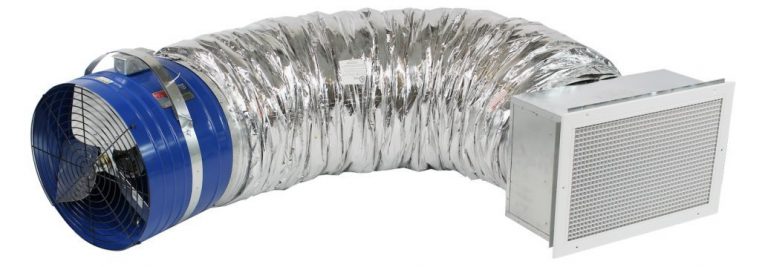
QuietCool fans are installed in a hanging position from the attic rafters, which puts the fans as far gone from your lebensraum as possible to reduce noise.
They can have multiple along/off switches if you want one fan to run in one part of the house but not in some other part. The QuietCool has no motorized doors or belts to replace, and the fan blades are not plastic. Information technology comes with a 10-year warranty.
The Larix laricina Technologies HV1600 unscathed house fan requires no maintenance and has an R-50 insulated doors, which, when non engaged, form an airtight seal 'tween your attic and livelihood space.
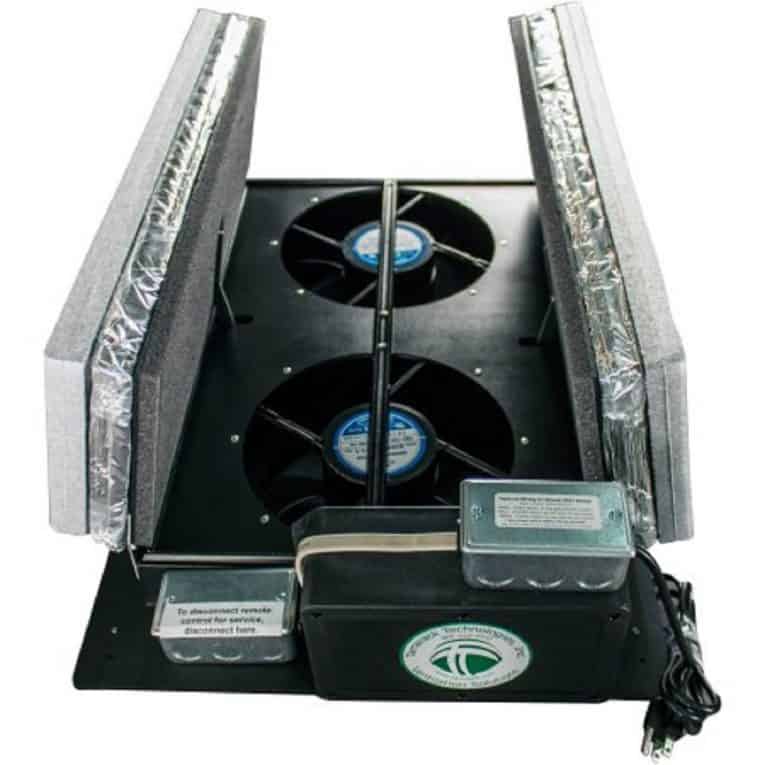
The "Specter" is a two-pep pill whole home devotee with a remote on-off switch. This is an easily installed and DOE-efficient large-diameter fan that closes and seals when not occupied. It comes with a three-year warranty.
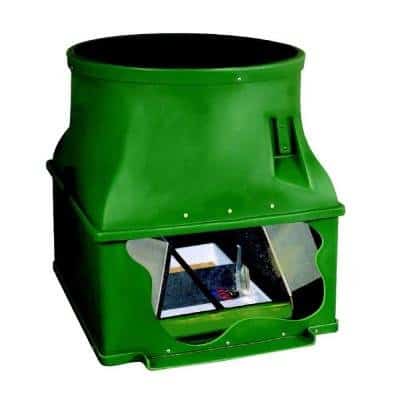
The "Superfan" is an Department of Energy-efficient whole house fan that does not need any upkeep. IT has one central unit with a German-ready-made fan motor called a transposed upcurved impeller motor, designed to pull large amounts of air through the publicize ducts quietly.
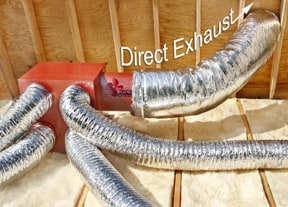
Information technology besides has an on/off switch and a radio set remote pick. The Superfan is rated for whol homes up to 3,000 square feet, though it is not recommended for homes in very cold climates. The cost is $1,550, with initiation estimated at between $400 and $500.
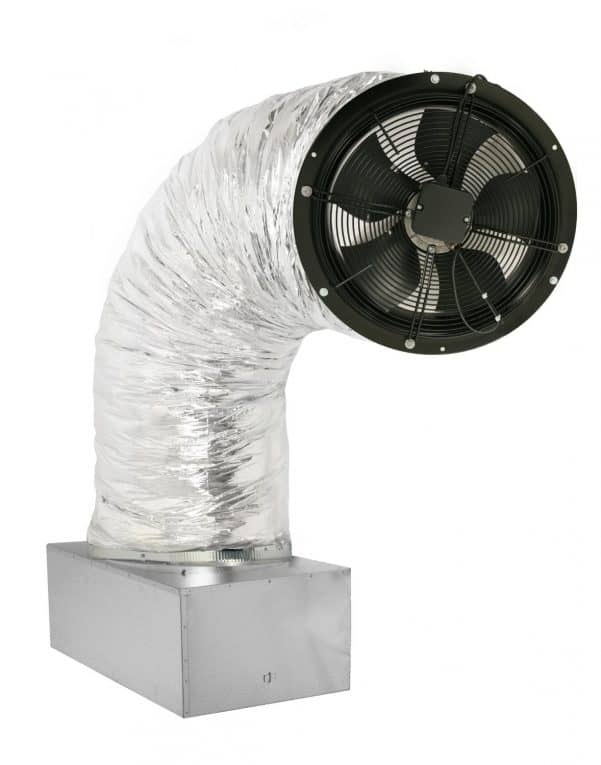
The Centric Air is a ducted, two-speed integral-house fan. Its collection plenum and wicket fits 'tween 16-edge or 24-inch on-shopping mall ceiling joists and the fan motor is located at the far terminate of the duct, keeping the motor noise away from the quarters. This makes this character of fan a good choice over bedrooms OR unusual living spaces where relaxing is important.
Find a Pre-Screened Local Whole-House Fan Installing Contractor
Direct Drive Whole House 30 Inch Fan Motor
Source: https://www.hometips.com/buying-guides/whole-house-fans.html


0 Comentários